
 Household, Living & Cooking
 Outdoor, Travel & Sports
 DIY, Garden & Animals
 Fashion accessories & Shoes
 Car & Motor
 Computer & Electronics
 Office & School
 Beautiful & Healthy
 Toys
Toys Eat Drink
 Baby
Baby Christmas
 King's Day


 8
8Garlic Presses for Sauces, Marinades and Everyday Cooking
Garlic Presses for Finely Crushed Garlic Without Repeated Chopping
Garlic can enter a recipe in several forms. You can slice a clove, chop it finely, grate it or force it through a press. These methods do not create the same texture. A garlic press pushes the clove through small perforations, producing a fine mass that can be distributed quickly through sauces, dressings, marinades and garlic butter.
At Discountershop, you can compare Garlic Presses by construction, grip and ease of use. Within Cooking Essentials, the garlic press has a specific purpose: processing small amounts of garlic efficiently without needing to chop every clove repeatedly with a knife.
What does a garlic press do differently from a knife?
When chopping garlic, you control how large or small the pieces remain. A press forces the clove through multiple small holes, creating much finer particles.
That finer texture creates more exposed surface area and makes it easier to distribute garlic through:
- vinaigrettes and salad dressings;
- marinades;
- garlic butter;
- pasta sauces;
- yoghurt dips;
- seasoning mixtures;
- soups and stews.
If you want visible slices or larger pieces, hand cutting gives you greater control. Use a stable Cutting Board and choose a knife suited to the size you want.
Leverage determines how much hand force you need
A garlic press works as a lever. You bring the handles together, transferring force to the clove inside the chamber.
That means the weight of the press alone tells you very little about how easy it will be to operate. Look instead at:
- handle length: longer handles can provide greater leverage;
- handle shape: broad, rounded handles spread pressure across more of your palm;
- hinge position: affects how force is transferred into the chamber;
- mechanism resistance: a stiff or poorly moving hinge requires more effort;
- chamber load: overfilling increases the force needed to close the press.
If you have limited hand or finger strength, leverage and handle comfort can matter more than appearance or total weight.
The same principle applies when comparing other Kitchen Utensils: grip, handle shape and required force can make a simple kitchen task noticeably easier or harder.
Chamber size determines how much garlic you can press at once
A large garlic chamber may seem automatically better, but that depends on how much garlic you normally use.
If most recipes require only one clove, a compact chamber may be easier to empty completely and clean. If you frequently prepare marinades or larger batches of sauce, a chamber that accepts several small cloves may save time.
Avoid filling the chamber so tightly that garlic escapes around the sides or the handles become difficult to close.
A garlic press is also not a universal food press. Hard nuts, dense root vegetables or other firm ingredients can require far more force than the mechanism was designed to handle. For other textures, Graters, Peelers & Slicers may be more appropriate.
Do garlic cloves need to be peeled before pressing?
That depends on the individual garlic press.
Some models are designed to process an unpeeled clove, leaving much of the skin inside the chamber while the garlic is pushed through the perforations. Other presses work more efficiently when the clove is peeled first.
Check the product instructions rather than assuming every garlic crusher can process unpeeled cloves.
If you press garlic with the skin still attached, remove the remaining peel before adding another clove. Otherwise the leftover skin can take up chamber space and reduce the efficiency of the next press.
For small peeling and precision-cutting jobs, a Paring Knife remains useful when preparing garlic or other small ingredients manually.
Why do garlic presses have different perforation sizes?
The number and diameter of the holes affect the texture of the crushed garlic. Smaller perforations generally produce a finer result but may also trap fibres more easily.
Larger holes allow more garlic to pass through with each squeeze and can be easier to clean, although the resulting texture may be slightly coarser.
When comparing designs, consider:
- total perforated surface area;
- how closely the pressing plate fits against the grid;
- whether garlic escapes around the sides;
- whether both sides of the grid are accessible for cleaning.
If a specialist task needs a completely different shape or mechanism, Other Kitchen Utensils can provide alternatives without forcing the garlic press to perform jobs it was not designed for.
Measuring garlic for repeatable recipes
A recipe may call for one garlic clove, but cloves can vary considerably in size. For everyday cooking, this usually does not matter. When you want more repeatable quantities, weight can be more useful.
Within Weighing & Measuring, different tools cover weight and volume.
A Kitchen Scale is useful when a recipe specifies garlic in grams rather than cloves.
For liquid marinades and dressings, a Measuring Jug helps measure oil, vinegar, water or other liquids before the crushed garlic is mixed in.
Clean a garlic press before the fibres dry
A garlic press contains exactly the areas where food easily becomes trapped: narrow perforations, chamber corners and the hinge.
Rinse the press soon after use rather than allowing garlic fibres to dry inside the grid. Open the mechanism fully and check both sides of the perforated plate.
Use a soft washing-up brush where necessary. Avoid forcing sharp knives through the holes because this can damage the grid and create a risk of cutting yourself.
Always check the care instructions before placing a garlic press in a dishwasher. Stainless steel construction does not necessarily mean every hinge, coating or handle component should be cleaned in exactly the same way.
If you organise several cooking tools together, Kitchen Utensil Sets can help you group equipment by function rather than storing every small item loose.
Garlic odour often remains where food residue remains
If a cleaned garlic press still smells strongly of garlic, inspect the chamber and hinge for small trapped fibres. Residue can hide around joints even when the main pressing surface looks clean.
Wash the press while it is fully open and allow it to dry completely before closing it for storage.
If garlic is being used in soup and you later need to lift ingredients from liquid, Skimmers & Whisks perform a completely different task from the press.
When transferring a finished dressing or sauce into a bottle with a narrow neck, a Funnel can make the next step cleaner and more controlled.
Garlic press or kitchen knife: when should you choose each one?
A Kitchen Knife gives you more control over the final shape and size. A garlic press prioritises speed and a consistently fine texture.
A Chef's Knife can handle several cloves at once and allows you to continue chopping until the garlic reaches the texture you want.
A Santoku Knife also works for many everyday cutting tasks, so garlic can be prepared alongside vegetables without changing tools.
If you regularly use several blade shapes, Knife Sets let you choose a combination suited to different preparation jobs.
For storage, protection and maintenance of those knives, Kitchen Knife Accessories should remain separate from the drawer space used for presses and other compact tools.
A garlic press does not replace every cutting tool
A Bread Knife uses a serrated blade for a completely different task and helps cut bread without unnecessarily compressing the crumb.
A Cleaver is designed for heavier chopping work and should not be confused with a compact pressing mechanism.
For meat preparation, Meat Knives provide blade shapes suited to different cutting tasks.
At the table, Steak Knives serve another purpose again.
Keeping these functions separate helps you use a garlic press for what it does best: processing small quantities of garlic quickly into a fine texture.
From crushed garlic to the finished dish
Garlic is rarely served on its own. Once pressed, it may be mixed into mashed potatoes, sauce, marinade or a cooked dish.
For mashed potatoes, use a Potato Masher after the potatoes have been cooked and drained.
If pasta, vegetables or other ingredients need to be drained before garlic is added, Colanders & Sieves handle that stage of preparation.
For cheese dishes, a Cheese Slicer performs another specific task without overlapping with pressing or chopping.
Once the dish reaches the table, Salt & Pepper Sets allow the final seasoning to be adjusted separately.
A Kitchen Timer can also be useful when crushed garlic needs to be added at a particular stage rather than cooked for the entire duration of a recipe.
Storing a garlic press cleanly and without unnecessary pressure
Allow the press to dry completely before putting it into a drawer. Water can remain around the hinge longer than it remains visible on the outer surfaces.
Store it so the handles are not continuously held under tension. Avoid placing heavy cookware or large utensils on top of presses with thinner handles or moving mechanisms.
In a small kitchen, compact tools can share one compartment, but keep the garlic press separated from exposed knife edges.
Watch Discountershop on YouTube
Visit the Discountershop YouTube channel for product videos and practical examples covering kitchen tools, cooking utensils and other products used for preparing, cooking and serving food.
Frequently Asked Questions About Garlic Presses
Why does a thin layer of garlic remain inside the press chamber?
The pressing plate cannot force every fibre through the perforations. A small layer therefore often remains against the grid. Remove this residue between cloves when pressing several pieces so the chamber does not gradually become obstructed.
How can you tell whether a garlic press will feel comfortable in your hand?
Check the distance between the open handles and the pressure needed to close them. Broad, rounded handles usually distribute force across the palm more comfortably than narrow edges that concentrate pressure in one spot.
Can you press several garlic cloves at the same time?
Yes, if the chamber has enough capacity. Avoid overfilling it because excessive garlic requires more force and may escape around the sides instead of passing cleanly through the perforated pressing plate.
Why does garlic sometimes squeeze out around the sides of the press?
This can happen when the chamber is overfilled, the clove is positioned poorly or the pressing plate does not align closely with the grid. Use less garlic and check that the mechanism closes fully.
Is a heavier garlic press automatically easier to use?
No. Weight does not determine leverage. Handle length, hinge position, grip shape and mechanical resistance have a greater effect on how much hand force is needed to push a clove through the perforations.
Can a garlic press also be used for ginger?
Only when the manufacturer indicates that it is suitable. Ginger is more fibrous and often firmer than garlic, so it can require greater pressure and may clog or strain a small pressing mechanism.
Why is it better to let a garlic press dry while open?
Water can remain trapped around the perforated plate and hinge when the press is closed. Leaving it open during drying allows moisture to evaporate before the tool is placed inside an enclosed kitchen drawer.
What is the advantage of a removable pressing plate?
A removable plate provides better access to the back of the perforations and chamber. This makes trapped garlic fibres easier to remove without pushing sharp objects through the small holes during cleaning.
When is a garlic press more practical than grating garlic?
A press is useful when you want to process one or more cloves quickly for a sauce or marinade. A grater offers control over very small amounts but requires greater care around its sharp surface.
When should a garlic press be replaced?
Replace it when the hinge becomes loose, the perforated plate bends, handles crack or sharp edges develop. A press that no longer closes straight also distributes force less efficiently and becomes harder to use.
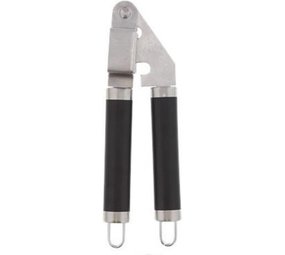
With this handy press you can pres...
With this handy press y...
Overige categorieën in Household, Living & Cooking
Garlic Presses for Sauces, Marinades and Everyday Cooking
Garlic Presses for Finely Crushed Garlic Without Repeated Chopping
Garlic can enter a recipe in several forms. You can slice a clove, chop it finely, grate it or force it through a press. These methods do not create the same texture. A garlic press pushes the clove through small perforations, producing a fine mass that can be distributed quickly through sauces, dressings, marinades and garlic butter.
At Discountershop, you can compare Garlic Presses by construction, grip and ease of use. Within Cooking Essentials, the garlic press has a specific purpose: processing small amounts of garlic efficiently without needing to chop every clove repeatedly with a knife.
What does a garlic press do differently from a knife?
When chopping garlic, you control how large or small the pieces remain. A press forces the clove through multiple small holes, creating much finer particles.
That finer texture creates more exposed surface area and makes it easier to distribute garlic through:
- vinaigrettes and salad dressings;
- marinades;
- garlic butter;
- pasta sauces;
- yoghurt dips;
- seasoning mixtures;
- soups and stews.
If you want visible slices or larger pieces, hand cutting gives you greater control. Use a stable Cutting Board and choose a knife suited to the size you want.
Leverage determines how much hand force you need
A garlic press works as a lever. You bring the handles together, transferring force to the clove inside the chamber.
That means the weight of the press alone tells you very little about how easy it will be to operate. Look instead at:
- handle length: longer handles can provide greater leverage;
- handle shape: broad, rounded handles spread pressure across more of your palm;
- hinge position: affects how force is transferred into the chamber;
- mechanism resistance: a stiff or poorly moving hinge requires more effort;
- chamber load: overfilling increases the force needed to close the press.
If you have limited hand or finger strength, leverage and handle comfort can matter more than appearance or total weight.
The same principle applies when comparing other Kitchen Utensils: grip, handle shape and required force can make a simple kitchen task noticeably easier or harder.
Chamber size determines how much garlic you can press at once
A large garlic chamber may seem automatically better, but that depends on how much garlic you normally use.
If most recipes require only one clove, a compact chamber may be easier to empty completely and clean. If you frequently prepare marinades or larger batches of sauce, a chamber that accepts several small cloves may save time.
Avoid filling the chamber so tightly that garlic escapes around the sides or the handles become difficult to close.
A garlic press is also not a universal food press. Hard nuts, dense root vegetables or other firm ingredients can require far more force than the mechanism was designed to handle. For other textures, Graters, Peelers & Slicers may be more appropriate.
Do garlic cloves need to be peeled before pressing?
That depends on the individual garlic press.
Some models are designed to process an unpeeled clove, leaving much of the skin inside the chamber while the garlic is pushed through the perforations. Other presses work more efficiently when the clove is peeled first.
Check the product instructions rather than assuming every garlic crusher can process unpeeled cloves.
If you press garlic with the skin still attached, remove the remaining peel before adding another clove. Otherwise the leftover skin can take up chamber space and reduce the efficiency of the next press.
For small peeling and precision-cutting jobs, a Paring Knife remains useful when preparing garlic or other small ingredients manually.
Why do garlic presses have different perforation sizes?
The number and diameter of the holes affect the texture of the crushed garlic. Smaller perforations generally produce a finer result but may also trap fibres more easily.
Larger holes allow more garlic to pass through with each squeeze and can be easier to clean, although the resulting texture may be slightly coarser.
When comparing designs, consider:
- total perforated surface area;
- how closely the pressing plate fits against the grid;
- whether garlic escapes around the sides;
- whether both sides of the grid are accessible for cleaning.
If a specialist task needs a completely different shape or mechanism, Other Kitchen Utensils can provide alternatives without forcing the garlic press to perform jobs it was not designed for.
Measuring garlic for repeatable recipes
A recipe may call for one garlic clove, but cloves can vary considerably in size. For everyday cooking, this usually does not matter. When you want more repeatable quantities, weight can be more useful.
Within Weighing & Measuring, different tools cover weight and volume.
A Kitchen Scale is useful when a recipe specifies garlic in grams rather than cloves.
For liquid marinades and dressings, a Measuring Jug helps measure oil, vinegar, water or other liquids before the crushed garlic is mixed in.
Clean a garlic press before the fibres dry
A garlic press contains exactly the areas where food easily becomes trapped: narrow perforations, chamber corners and the hinge.
Rinse the press soon after use rather than allowing garlic fibres to dry inside the grid. Open the mechanism fully and check both sides of the perforated plate.
Use a soft washing-up brush where necessary. Avoid forcing sharp knives through the holes because this can damage the grid and create a risk of cutting yourself.
Always check the care instructions before placing a garlic press in a dishwasher. Stainless steel construction does not necessarily mean every hinge, coating or handle component should be cleaned in exactly the same way.
If you organise several cooking tools together, Kitchen Utensil Sets can help you group equipment by function rather than storing every small item loose.
Garlic odour often remains where food residue remains
If a cleaned garlic press still smells strongly of garlic, inspect the chamber and hinge for small trapped fibres. Residue can hide around joints even when the main pressing surface looks clean.
Wash the press while it is fully open and allow it to dry completely before closing it for storage.
If garlic is being used in soup and you later need to lift ingredients from liquid, Skimmers & Whisks perform a completely different task from the press.
When transferring a finished dressing or sauce into a bottle with a narrow neck, a Funnel can make the next step cleaner and more controlled.
Garlic press or kitchen knife: when should you choose each one?
A Kitchen Knife gives you more control over the final shape and size. A garlic press prioritises speed and a consistently fine texture.
A Chef's Knife can handle several cloves at once and allows you to continue chopping until the garlic reaches the texture you want.
A Santoku Knife also works for many everyday cutting tasks, so garlic can be prepared alongside vegetables without changing tools.
If you regularly use several blade shapes, Knife Sets let you choose a combination suited to different preparation jobs.
For storage, protection and maintenance of those knives, Kitchen Knife Accessories should remain separate from the drawer space used for presses and other compact tools.
A garlic press does not replace every cutting tool
A Bread Knife uses a serrated blade for a completely different task and helps cut bread without unnecessarily compressing the crumb.
A Cleaver is designed for heavier chopping work and should not be confused with a compact pressing mechanism.
For meat preparation, Meat Knives provide blade shapes suited to different cutting tasks.
At the table, Steak Knives serve another purpose again.
Keeping these functions separate helps you use a garlic press for what it does best: processing small quantities of garlic quickly into a fine texture.
From crushed garlic to the finished dish
Garlic is rarely served on its own. Once pressed, it may be mixed into mashed potatoes, sauce, marinade or a cooked dish.
For mashed potatoes, use a Potato Masher after the potatoes have been cooked and drained.
If pasta, vegetables or other ingredients need to be drained before garlic is added, Colanders & Sieves handle that stage of preparation.
For cheese dishes, a Cheese Slicer performs another specific task without overlapping with pressing or chopping.
Once the dish reaches the table, Salt & Pepper Sets allow the final seasoning to be adjusted separately.
A Kitchen Timer can also be useful when crushed garlic needs to be added at a particular stage rather than cooked for the entire duration of a recipe.
Storing a garlic press cleanly and without unnecessary pressure
Allow the press to dry completely before putting it into a drawer. Water can remain around the hinge longer than it remains visible on the outer surfaces.
Store it so the handles are not continuously held under tension. Avoid placing heavy cookware or large utensils on top of presses with thinner handles or moving mechanisms.
In a small kitchen, compact tools can share one compartment, but keep the garlic press separated from exposed knife edges.
Watch Discountershop on YouTube
Visit the Discountershop YouTube channel for product videos and practical examples covering kitchen tools, cooking utensils and other products used for preparing, cooking and serving food.
Frequently Asked Questions About Garlic Presses
Why does a thin layer of garlic remain inside the press chamber?
The pressing plate cannot force every fibre through the perforations. A small layer therefore often remains against the grid. Remove this residue between cloves when pressing several pieces so the chamber does not gradually become obstructed.
How can you tell whether a garlic press will feel comfortable in your hand?
Check the distance between the open handles and the pressure needed to close them. Broad, rounded handles usually distribute force across the palm more comfortably than narrow edges that concentrate pressure in one spot.
Can you press several garlic cloves at the same time?
Yes, if the chamber has enough capacity. Avoid overfilling it because excessive garlic requires more force and may escape around the sides instead of passing cleanly through the perforated pressing plate.
Why does garlic sometimes squeeze out around the sides of the press?
This can happen when the chamber is overfilled, the clove is positioned poorly or the pressing plate does not align closely with the grid. Use less garlic and check that the mechanism closes fully.
Is a heavier garlic press automatically easier to use?
No. Weight does not determine leverage. Handle length, hinge position, grip shape and mechanical resistance have a greater effect on how much hand force is needed to push a clove through the perforations.
Can a garlic press also be used for ginger?
Only when the manufacturer indicates that it is suitable. Ginger is more fibrous and often firmer than garlic, so it can require greater pressure and may clog or strain a small pressing mechanism.
Why is it better to let a garlic press dry while open?
Water can remain trapped around the perforated plate and hinge when the press is closed. Leaving it open during drying allows moisture to evaporate before the tool is placed inside an enclosed kitchen drawer.
What is the advantage of a removable pressing plate?
A removable plate provides better access to the back of the perforations and chamber. This makes trapped garlic fibres easier to remove without pushing sharp objects through the small holes during cleaning.
When is a garlic press more practical than grating garlic?
A press is useful when you want to process one or more cloves quickly for a sauce or marinade. A grater offers control over very small amounts but requires greater care around its sharp surface.
When should a garlic press be replaced?
Replace it when the hinge becomes loose, the perforated plate bends, handles crack or sharp edges develop. A press that no longer closes straight also distributes force less efficiently and becomes harder to use.
